
2026.005.016 Joanne Armstrong
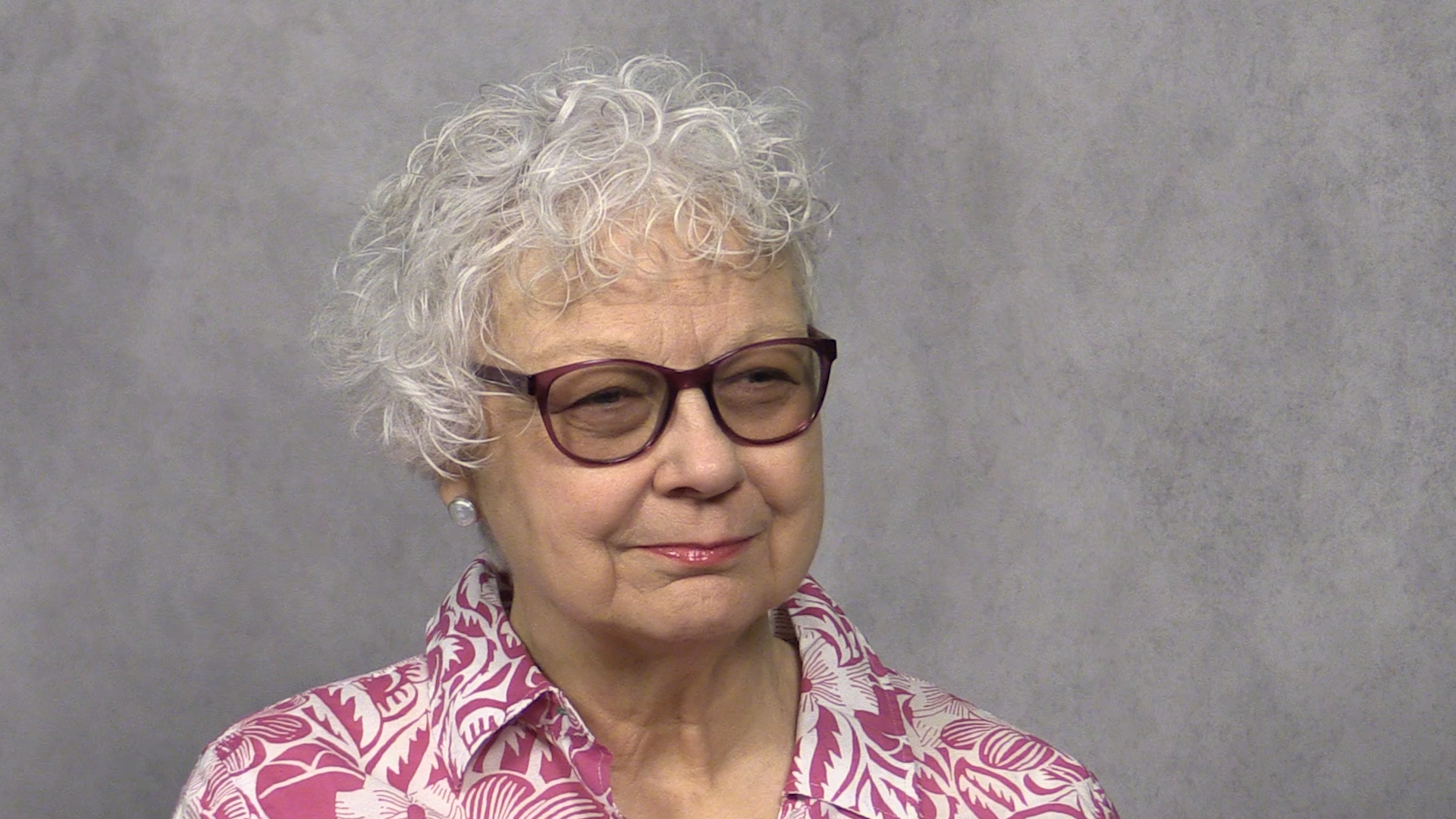
BIO INFO: Joanne Armstrong is a life long resident of Middletown, Delaware. Her family owned a large farm north of Middletown on Rt. 896. The original house that her ancestors built in the 1800s still stands and she lives in it with her husband. Her father was a dairyman and her mother grew a garden each year. Joanne spent her career as a Librarian, first at the Louis L Redding Middle School and then in Baltimore County, MD. She was instrumental in the start of an organization to address Progressive Super Nuclear Palsy.
TOPICS AND SUBJECT MATTER KEYWORDS: Farming, Family Heritage, Education, Religion, Community History, Career
TO VIEW SUBTITLES, PLEASE SELECT THE CLOSED CAPTIONING (CC) ICON AT THE TOP RIGHT OF THE VIDEO.
Recording Inventory Sheet: Joanne Armstrong
Digital Collections Sheet: Joanne Armstrong
Middletown Historical Society
Middletown, Delaware Oral History Series
Speaking of the Past: Conversations
With Long-Term Residents of
Middletown, Delaware, 1900 – Present
Interview with Joanne Armstrong
May 18, 2026
Middletown Historical Society Oral History Transcript
Joanne Armstrong – Youtube – 05182026
Interviewer: Patricia L Peirson Maichle
Pat: Okay. Good morning.
Joannne: Good morning.
Pat: How are you this morning?
Joanne: I’m fine, thank you. In this hot weather.
Pat: Yes, I noticed. Um, I’m Pat Maichle. I’m a volunteer with the Middletown Historical Society. And Keith Schneider is our videographer. He’s here as well. And we are in the Appoquinimink Community Library in Middletown, Delaware. Welcome. Relax.
Joanne: Thank you.
Pat: And we’ll go through these questions. What the Historical Society is attempting to do is to demonstrate the history of Middletown through your memories and experiences that you’ve had throughout your life. And we’re hoping to capture among all of the videos the time between the 1900s and present.
Joanne: I see.
Pat: So, we’ll get started. What is your full name and do you have a nickname?
Joanne: Joanne Elizabeth Armstrong. Uh friends from long ago, only one or two call me Josie.
Pat: Okay. When and where were you born?
Joanne: I was born here in Middletown. And you want the year.
Pat: Yes.
Joanne: September 16th, 1946.
Pat: Were you born at home?
Joanne: No, I was born in I don’t recall which hospital, but one in Wilmington.
Pat: Okay. How did your family come to live here?
Joanne: Um, my family first came to the United States of America and were in Hagerstown and then came to this part of the territory in the early 1700 1800s because there’s a record of my relative uh voting for Thomas Jefferson. And it was this area and uh that’s when we first came here.
Pat: And you’ve uh your family had a farm, right?
Joanne: We have a farm.
Pat: How many generations were
Joanne: Let’s see. I’m counting up. Father, grandfather, and great grandfather. And great-grandfather was born in 1834. So.
Pat: Okay.
Joanne: Don’t recall exactly when it was established.
Pat: Okay. Were there other family members in this area when they moved here originally?
Joanne: That I don’t know. Um I know there is a branch of Armstrongs in the Odessa area. I just don’t know.
Pat: Okay. What was the house that you grew up in like? How many rooms did it have? Did it have electricity, indoor plumbing, telephone?
Joanne: I grew up in a um brick house. Don’t, husband would correctly name the architectural term, but it was built in about uh 1859 just south of Armstrong Corner. And the bricks came from the brick factory at Armstrong Corner. I don’t recall which corner that was. Uh how many rooms? It’s deceivingly. It looks larger because it’s built on an L-shape. So, there are four rooms upstairs, a four-room attic, four rooms downstairs, and there was a brick uh it was a brick house, but there was a wooden addition for the present kitchen that was 1889.
Pat: And did you have indoor plumbing when you were growing up and electricity?
Joanne: Yes, in electricity. Um, my father recalls, yes, there were it was lit by gas when he was growing up. He was born in 1904. I The electricity came, I believe, in the 30s. Yes. Indoor plumbing, but there was an outhouse and facilities inside until the real bathrooms got installed about I think 1954, 1955.
Pat: Okay. What is your earliest childhood memory?
Joanne: Oh gosh.
Pat: Good or bad.
Joanne: Right. That I don’t recall uh earliest. I do remember just now my mother taking me to first grade at the newly built wing of what is now the Everett Meredith Middle School and then was the Middletown School which held first grade through 12. I probably have some memories before that, but that’s what flashed in my mind. Oh, I went to uh preschool. I don’t know what the term was, whether it was kindergarten or something else at the Episcopal church uh in Middletown. St. Ann’s Episcopal Church.
Pat: Okay.
Joanne: So, I would have been what, four or five at that time.
Pat: Was was going to school the first day a big excitement for you or?
Joanne: Yes.
Pat: that you remember
Joanne: A little bit of oh my gosh this is so new and my mother’s going to leave me here. Uh but soon adjust it. That’s all I recall of the that little nervousness of first grade first day.
Pat: What kind of games did you play growing up?
Joanne: Uh board games. I remember playing um with a classmate Diane Insulo, that’s her maiden name, and she lived in Middletown. Piggly Wiggly and other kinds of things in what were we second or third grade. Um I don’t recall what games we played at home until I was old enough to learn a card game of Canasta. And my parents and I played Canasta often and with a friend.
Pat: Did you play outdoor games at all?
Joanne: No, I wasn’t athletic. Um, I do uh do recall croquet, setting up a croquet set in a rather uneven front lawn. Uh, and in the 50s the hula hoop came in, but other than that, that’s all I recall at the moment.
Pat: Okay. What was your favorite thing to do for fun? So, go to the beach, go to the movies, something else.
Joanne: Um, reading. Um, my father was a dairyman, so he was pretty much kept at home and my mother didn’t drive, so excursions outside the home were far between and depended on other people growing up, etc. Um favorite excursion. Yeah.
Pat: Or or any
Joanne: Oh, the movies. Going to the Everett movies. I remember growing up the Lions Club, I believe, or was it Rotary had a Christmas show for youngsters. Uh and that would be a movie and they gave out treats.
Pat: Did you have family chores? And if so, what were they? And what was your favorite?
Joanne: Oh my. Um, I was an only child and a girl. And my father was very much, I guess, um, women’s work is inside, men’s work is outside. I uh, drove the tracker tractor when it was fun, and then when it got to be work at age 12, I didn’t drive it anymore. Um indoors, a little bit of cooking, some dusting and straightening up, but nothing more definitive than that growing up.
Pat: Okay. What was school like for you as a child? What were your best and worst subjects and where did you attend? You had said you went to the Middletown school. Um and did you go to college?
Joanne: Uh, best and worst subjects. I liked history and English. Um, worst subjects. I don’t believe we had much of science until science, I would say, was my worst subject until I got into fourth grade and fifth grade when we had a separate science book. Uh, I would say science would be my worst.
Pat: Did you go to college?
Joanne: Oh yes, I did go to college. I went to the University of Delaware and then later on for my career uh furtherance I went to Catholic University in Washington, D.C. to get a master’s in Library Science.
Pat: Was that your major in college?
Joanne: History and American studies in college and then after I became employed as librarian at Redding Middle School, I went to uh the University of Delaware and took credits in Library Science so that I could be certified to work in the state as a librarian.
Pat: Okay. Do you remember any fads in your youth like popular hairstyles or clothes?
Joanne: I came in at the end of the poofy uh Poodle skirts uh fads. Um the jitterbug. I don’t remember about the hair until later like in the in the 60s when it got all poofy. Um that’s all I recall the other fads.
Pat: Okay. What were your favorite songs and music?
Joanne: Oh gosh. I was in the uh beginning of the rock and roll era. Um and I liked mostly music of the day. Not classical, not real country, but music of the era. Um favorite song, nothing pops to mind at the time. Oh, and then of course we were all excited when there was the English invasion in 1964 and um I was a senior in high school at that time.
Pat: Did you swoon at the Beatles?
Joanne: Yes.
Pat: Did you go to the dances?
Joanne: Yes, at the high school. And then at the time the Lions Club also had dances which were held what was then the Armory and you can probably recall what street that was. Uh they would be in the summertime.
Pat: And all the kids went to the uh the Armory for dances?
Joanne: Yes. Yes. Uh there would be oh gosh 60 80 100 I’m not exactly sure. Yeah.
Pat: Okay. Did you have any pets? And if so, what kind? And what were their names?
Joanne: We always had a Chesapeake Bay as an outside dog growing up, Lizzy. And then my mother was uh fond of a rat terrier and we that was the inside dog. Now, we didn’t I would call them pets as they were in their later life. My father had work horses uh that he kept and did not particularly use as draft horses since he had a tractor, but he kept them there until they died. And one was Edith. Um she died when I was in fourth grade, but I would go and get her by put a halter on her, I think. Yes. Not a bridal, and pull her up to a fence and climb up and get on her or else take her down to the tree that’s midway in the lane. Climb the tree and get on her back. I rode bare back and if I fell off, she would stand there and wait for me.
Pat: That’s a good horse. And you had a friend who used to borrow Edith.
Joanne: Yes, our neighbors up the road. Everett Meredith didn’t have a tractor in the early 50s, so he would send his daughter Patsy to walk down what was, what was the measurement? 3/10, 4/10, half a mile to our house and get Edith and ride her back so that Mr. Meredith could use her uh in plowing. And then she would have to ride the horse back. And she tells the story that, bare back, that she tells the story that she always got a little nervous as she approached our house because her male friend would winnie and if she heard him, she would go faster and faster and faster.
Pat: Edith.
Joanne: Edith would and she was afraid of falling off being back. No saddle.
Pat: We did hear that story. What was your religion growing up and what church did you attend?
Joanne: Uh, Methodist and I attended the Bethesda United Methodist Church on East Main Street.
Pat: Do you still go?
Joanne: as a child. Yes, we’re I’m a member at present.
Pat: Were you ever mentioned in the newspaper or other publications?
Joanne: Well, yes. I recall during high school when um I was had some function as in selling ads for the upcoming yearbook and that would be published in the newspaper in the Transcript with a photograph of perhaps selling the ad. Um during the plays that I was in and photograph of those. That’s my earliest remember. I remembrance of that. I don’t recall later on.
Pat: Did you keep copies of those Transcripts?
Joanne: Perhaps so. I couldn’t tell you where they are now.
Pat: They’re good history.
Joanne: Yes, good history.
Pat: Who were your friends when you were growing up?
Joanne: My friends were, of course, my neighbor Patsy Meredith, now Patsy Meredith Warner, Linda Brady, uh Diane Insulo, Judy Steel, who when I was in gosh, sixth or seventh grade, unfortunately, moved to Smyrna and I was very upset. Barbara Sheets, Lynn Money.
Pat: All the big names in Middletown.
Joanne: Yes. And the boys, who who were the boys that I was closest to? Murray Smith, Gene Pratt.
Pat: Pratt’s Hatchery.
Joanne: Yes. Pratt’s Hatchery.
Pat: What world events had the most impact on you while you were growing up? And did did any of them personally affect your family?
Joanne: World events.
Pat: Wars or big things like that?
Joanne: Uh, unfortunately I don’t recall world events. Oh, yes, I do. Here comes one. When uh I was in elementary school and it was the Cold War, we would have the drills of getting off your seat and either hovering under the desk or hovering into the hall facing the wall and covering your heads because there was going to be some kind of an attack uh because of Cold War.
Pat: Was that frightening?
Joanne: I don’t recall that it was particularly, no. It was just, oh, here we go again. We’ve got to do this. Right.
Pat: Okay. Right. Were any of your family members in the wars? Served in the wars?
Joanne: No, my uh father was not because he was needed at the farm. I don’t know what kind of exemption that was other than his age, right? Born in 1904, he would have been too old for World War II and too young for World War I.
Pat: Okay. How are holidays such as birthdays and Christmas and Easter or whatever you celebrate, how are they celebrated in your family? And do you have special traditions?
Joanne: How were they at growing up? That kind of thing.
Pat: Yeah.
Joanne: Yes. Uh, at Christmas, I think as a lot of people, we didn’t put a Christmas tree up until almost Christmas. I recall my parents asking me, would I like to help them put the Christmas tree up Christmas Eve or would I like Santa Claus to bring it? And of course, I love the surprise of getting up and seeing it Christmas morning. So, I would say, I want Santa Claus to bring it. So, Christmas morning would come and I would get up at 5 or 5:30 and knock on my parents’ door. “Get up, get up. It’s Christmas.” And of course, they might have had two or three hours sleep making all the preparations. Um traditions, there were no traditional food or other thing that I recall, but that was the tradition I most recall growing up.
Pat: How about Thanksgiving?
Joanne: Thanksgiving? No. Unfortunately, coming from a very small family, it was always just the three of us. Um I remember later life in high school and college, we would ask my father’s cousin to come down from Wilmington, but her response would be, “Oh, no, that’s for family.” Well, isn’t she family? But it was always just the three of us.
Pat: Okay. How is the world different today than it was when you were a child?
Joanne: Much faster. Much more aggressive traffic. Much um, how do I describe this? We all have less of an attention span, don’t we? Because of social media and TV. Um people paying attention, slowing down, listening to other people. Yes.
Pat: What do you know about your family surname? You said a couple of things.
Joanne: Surname Armstrong, right? Way back in history, the Armstrong was Scottish, Scotts Irish. And the Armstrong name came from uh the Scotts raiding the Armstrongs raiding the southern borders and keeping the southern borders safe from the English. Um and a, no, I was that’s the wrong surname. That’s my husband’s surname. I was about ready to mention history of his.
Pat: That’s okay. Uh go back to yours.
Joanne: His name is Janny. J A N N Y. And uh I asked him when we got married if he didn’t mind if I kept my maiden name which was Armstrong because after all I was in my late 40s and Armstrongs had lived at Armstrong Corner and I needed an Armstrong to live there. But I digressed. He we found later in life uh maybe 20 25 years ago there was a Janney in Canada that had written a book about the Jannitys. I’m sorry the Jannys and their um travel to the United States.
Pat: That’s exciting.
Joanne: Yes.
Pat: Did you ever get a copy of it?
Joanne: Yes. I do have a copy of it.
Pat: That’s a gift.
Joanne: Yes.
Pat: I think. Is there a naming tradition? Well, you you it’s only you. Is there a naming tradition in your family such as always giving the firstborn son the name of his paternal grandfather? Did you find that with your grandfather or father?
Joanne: Yeah, there were a lot of Benjamins. Uh my father was Benjamin Irvin Armstrong, but he always went like be Irvin and people called him Irvin. His father was Benjamin Vance, and all of a sudden, I’m having a blank on the father before that but it seems like there was a similar name.
Pat: Okay.
Joanne: It might even have been Benjamin.
Pat: Okay. Considering that we are celebrating the 250th anniversary of our country this year, what stories have come down to you about your parents, grandparents, or more distant ancestors and their service to America?
Joanne: Unfortunately, I don’t recall discussing any service to America that any of my family was involved in. What came to mind was my father when he was dating my mother in the 40s. Um, my mother worked at her brother’s luncheonette near the four corners and if they received a telegram that needed to get to a family of a service member, sometimes my father would take that telegram out to that house. And of course, he didn’t like that duty or
Pat: Yeah.
Joanne: job he was given or volunteered for.
Pat: That’s a big thing. Did Did you, well, maybe you, but did your family do a lot of volunteer work besides that? That is a service.
Joanne: No, not that I recall because there was, we were so busy with the farm. My father as a dairyman milking cows two times a day. He did have help. And um my mother could not drive and in the summer had a had a large garden that we took care of.
Pat: Did your dad use the um his hands or the electronic milking machines at that point?
Joanne: I always remember the electronic milking machines, right. Yes. And we um put the milk in milk cans that were picked up until the sometime in the 1950s when there came a milk tank that we could uh use and keep cool. And then a big tanker came and picked that up. And one memory I have is one snowy day and the tanker got stuck um after I think he had loaded up and my father, there’s a photograph of this somewhere taking one of the draft horses and trying to pull the tanker with his draft horse. I don’t recall the end of the story.
Pat: Oh, that’s a shame. That would be like a a TV movie or something.
Joanne: I don’t recall the the driver having to stay overnight or anything, so they must have gotten it out.
Pat: Those were the days. Are there any stories about famous or infamous relatives in your family?
Joanne: I don’t recall any.
Pat: Okay. Are there any special heirlooms, photos, Bibles, or other memorabilia that have been passed down in your family?
Joanne: There’s a photograph taken in the late 1800s of my must have been before 1899. My grandfather married in 1899. Of him standing in front of the house uh at Armstrong Corner and behind him are a horse and someone, an employee, holding the horse, and a woman which was probably a housekeeper and her child and that is the oldest uh memorabilia or visual memorabilia we have of the house. And then there is a photograph of the grandmother’s side, the Hendrickson side, of her house at Barley Mill Road, uh, which was what, 1700s, early 1800s. We do have an old family Bible and in which there are newspaper clippings and that kind of thing that someone in the family gave to us. So, I have not been through it totally.
Pat: Okay, that’s exciting. I’m a history nut. Um, what was the full name? Well, what is the full name of your spouse, your siblings, and your parents?
Joanne: Um, I’ll start with parents. Benjamin Irvin Armstrong. Irvin Armstrong. Elizabeth Buff Armstrong. She was known as Buff because when she was small, her 18-month-old older brother could not pronounce Elizabeth, so she became Buff. And uh my husband is Richard Allen Janney and his son is Richard Hamilton Janney.
Pat: Okay. When and how did you meet your spouse and what did you do on dates?
Joanne: We met uh thanks to a neighbor of my husband’s. I was working as a librarian in the Baltimore County school system and both of his neighbors, the wife and the husband, were Baltimore County Librarians as well. My husband, um his first wife had died and later in the year he needed a date for a business occasion and the neighbor, Fred Mengers, took over my name and number on a pink piece of paper and uh he called me. And uh what did we do on dates? That first date, I think the business thing fell through, but we went to the Baltimore Symphony Orchestra, Gayla. Um, we would go to the movies or to plays, I don’t other recall, out to dinner. Um, and when we married, the people next door who had introduced us wrapped a wedding present with uh photographs of that pink piece of paper as the wrapping paper.
Pat: Oh, that’s neat. Where and when did you get married?
Joanne: We got married July the 15th, 1995 in the church I was a member of at the moment in Randistown, Maryland, which is a suburb of Baltimore. It was memorable because that was the hottest day of the century. Um, it was 106°,126 heat index. And a bridesmaid said to me, “God said, Joanne is finally getting married. I’m going to make it memorable.”
Pat: That is memorable. How would you describe your spouse? So, something more than just what what color is his hair. But
Joanne: Tall, very talented and crafty with his hands. Has all sorts of projects. um wood projects, metal projects. Um, and a sportsman, a uh skeet shooter in his career. He did a lot of skeet shooting, was asked to join the Olympic team try-outs and those are the things he does. But personally, very generous, very caring, very conscious of other people.
Pat: And what do you admire most about him?
Joanne: Oh, his generosity, his caring for other people, his willing to help someone in need.
Pat: Okay, those are all good things. What did what does your family enjoy doing together? You and he and I guess his son.
Joanne: Yes. Um just going out to what might be any special events. We don’t have anything uh in mind particularly. Oh, we do um belong to the Delaware subscribe to the Delaware Theater Company and there are five productions a year and that’s in Wilmington. And we meet my college roommate and her husband who come down from West Chester, Pennsylvania. We all attend the theater and then we have dinner afterwards.
Pat: Okay. Well, well, you kind of mentioned this. What was your profession and how did you choose it?
Joanne: Librarian. And I chose it because I’d always liked history and English. And how did I choose it? Um, I in the early summer of my graduating year from college, 1968, I did not have a job yet. I’d gone on some interviews. Um, some my advisor said, “Don’t even take that one. That’s too many preparations for a beginning teacher.” And the second one, I couldn’t coach football. So anyway, uh I was uh at the Meredith house and Everett Meredith said, “Well, you know, we don’t have a Librarian at Redding Middle School yet.” And so that was my application for that job and because he knew my background. And so, I became um a Librarian at middle the middle school and really enjoyed it because that solved the problem of history and American studies and and English. And
Pat: That’s neat. That’s a neat story. If you could have had any other profession, what would it have been?
Joanne: Psychology. And I’ve thought about that in recent years. Uh I did very well in Psychology at school and I recall a very helpful course in communication, in personal communication, that was an um multi-day in-service course when I was employed as a Librarian but that was very impactful.
Pat: What accomplishments are you the most proud?
Joanne: Um, starting the accomplishments I’m most proud of is helping to start an organization for a rare neurological disorder that my father was affected by. In the 1980s, he was diagnosed with Progressive Super Nuclear Palsy. This has recently come to national attention because of the celebrities, um Dudley Moore and most recently the Reverend Jesse Jackson also suffered from that disorder. In the beginning of the disease, it’s often thought of as Parkinson’s with the gate and the speech, but as it progresses, other features come to the fore. And uh it’s the movement of the eyes and the inability to keep them level. The Super Nuclear refers to the part of the brain that has that ability to keep the eyes steady. Um, and how that all evolved was, um, I received a phone call from another gentleman in the Baltimore area who said, “I found your name on the list of people who had written to the um, National Organization of Rare Disorders about this disorder, Super Nuclear Palsy, and said they would be willing to speak with other people. And you’re the only other person on that list of 32 that’s in the area. Let’s talk about getting together and starting an organization to promote research and help to families. And that was in 1990, unfortunately, just 10 days after the death of my father. So, he never knew that was going to happen. But uh now that uh we were in Baltimore for um the organization for totally a volunteer organization until 1995 and then we got our first employee and for the last eight or 10 years we’ve been in Manhattan and have 15 or more employees to support our outreach, our research, our service to families.
Pat: That’s exciting. How has the recent development affected the area in Middletown and around? That’s a big question, I know.
Joanne: I often go back to the thought that gosh, I can’t as send a child as I did when I was in fifth and sixth grade on my bike up to Armstrong Corner and ride by myself all down Chop Tank Road and then come into Middletown and come back out. That would be very scary now with all the impact of the multitudes of cars, the traffic, the impatience and the aggressiveness of drivers that I believe we have now that we didn’t have in a more laid-back era.
Pat: Anything else? There are so many things.
Joanne: Read the question, again, please.
Pat: How has the recent development affected the area?
Joanne: Oh, okay. There’s a development around the house.
Pat: Yeah, that’s true.
Joanne: Um, in uh what 2018? I’m trying to. It doesn’t matter. We sold the property uh which is now where Wawa is, the northern field before Armstrong’s Corner. And it about four years ago, there were town houses that are now built to the north and to the west of the 2.99 acres that remain with the house. So, uh, we now have a number of neighbors, close neighbors. And as my husband says, I can’t go out and shoot a groundhog now. That’s been a nuisance on the property with the neighbors here.
Pat: He could, but he’d get in big trouble.
Joanne: Yes.
Pat: That’s the way it used to be, though. How has the community changed? So, if you think about it, culturally, financially, uh, educationally, religiously, we have a lot more churches than we ever had back in the day. Those kinds of things.
Joanne: Well, we were very much an agricultural community when I was growing up. You had to go to Newark or Wilmington or Dover for other employment other than the few businesses that were in Middletown; the jewelry store, the department stores, the Silcos or Acme. Um would you rephrase the question again? What other kinds of
Pat: How has the community changed?
Joanne: The community changed. Thank you. The uh influx of people have has brought a surprising amount of variety of backgrounds, of cultures, of people coming from high employment areas. And I was surprised to read the median income of residents in this area seemed very high. I’m not going to quote it because I don’t recall what it is now. Um, I recall having a conversation with people, a couple who’d come here out from who lived about 30 miles from Greenwich, Connecticut. And they moved here about two years ago or so and remarked about how the traffic was so much better here. I hear that often too from other people whereas we natives are like, “Oh my gosh, the traffic is so awful.” Um, but how is the community? There are many more cultural opportunities that we can take advantage of. The Everett has great programs, theater and art. Um, how has the community changed?
Pat: In every way. In every way.
Joanne: That’s all I can think of at the moment, unless you want to give me a hint.
Pat: That’s okay. That’s okay. What do you want people to know the most about yourself, your family, their business, etc. Something that they will hopefully when they watch this video, it will explain who you are and what they can remember into the future.
Joanne: Chronologically um I would say my father’s and grandfather’s interest and in the dairy industry in Purebred Holstien Frisian cows from the late 1800s and my father had a yearling bull that was con considered second in the nation in his age group about 1960 or 61. Um, and that was published in the uh Breed Magazine, Holstien Frisian World. Um, and for myself, the fact that I helped to start this organization that now supports other families and research for this rare neurological disorder and hope that we find an answer as our scientific research person said, I think in our lifetime. So that should be soon for my lifetime. But uh anyway.
Pat: How about how about the lives you affected while you were a Librarian? I mean at the elementary school, just think about what effect you had on those kids.
Joanne: Well, sometimes e even um people do come up to me. I remember be from my career in Baltimore. I was getting um my hair done in a shop and the manicurist from next door came over and said, “Oh, Miss Armstrong, I remember how you would save the newest copy of such and such magazine for me and put it under the counter.” Uh, I remember one time being in the grocery store in Middletown and a big hall strapping guy said, “Oh, Miss Armstrong, do you remember me? I was the guy with the big smile in seventh grade.” And of course, he was now 6’2 or three and weighed 200 lb. And unfortunately, I didn’t remember him. But from time to time, I have people say something. Right.
Pat: And they’ll remember that forever. What do you want people to know the most about Middletown’s past?
Joanne: It has a proud tradition that the Middletown Historical Society is trying to preserve. First of all, in agricultural a proud history, in the early businesses of course the Witherspoon Inn where Thomas Jefferson and George Washington stopped, the architecture of the downtown, um the outlying peach mansions that were built due to the great peach industry that came into this area in the 1800s and was late 1800s and was unfortunately wiped out by the peach blight. Um, I remember there was an article in the Transcript Historical column once about how many railroad cars of peaches had gone out to New York during or Philadelphia during a day or a week. It was astronomical. Um, sadly some of those Peach mansions are disappearing, but I hope they can be repurposed, adaptive reuse.
Pat: Do you um are you involved with the Peach Festival? Do you want to talk a little bit about that?
Joanne: Um I was involved more so early on. Um I was a judge for the parade one year. Unfortunately, in later years, it’s it’s been at the time period when I am out of town. Um but I do whatever I can that I’m asked to do or volunteer for.
Pat: Okay.
Joanne: In the early years, um, in the 1990s, we particip my husband and I participated in the parade and drove an antique car.
Pat: Do you know why we continue to have the peach festival? What’s the historical background of the
Joanne: Of the peach festival, itself?
Pat: Well, the reason that we have it every year.
Joanne: Well, the reason why we have it is to raise money to support the um the Middletown Historical Society. And with that money, we are able to pay a person who I don’t want to define her job too much uh because I will get it wrong, but um is contracted to look over the collection and we put up exhibits. We have, we are in the old Academy Building which was previously the Old Academy School building where people went to school until it trans was closed. I don’t know what year. And then it became the Town Hall. And then when they moved to the new building the town council town services did the Middletown Historical Society is able to use that space. So, we use that money for exhibits and for preserving items that we are given and for employees and interns and needed expenses there.
Pat: Okay, those are all the questions that I have. Do you have anything you want to say outside of those? Do you want anything to leave us with? Some sage advice maybe?
Joanne: Not that I recall until I get five minutes down the road. Right. As it often happens. Uh but I hope that particularly the newcomers to this area come to appreciate the history that we have in Middletown and will come and visit the Historical Society and see our displays of what that history is of the peach era, the peach festival. Well, the peach industry here. We have that permanent um exhibit and the proud history of the Academy. We have an exhibit of uh a school room, right? And my father went to that school and I said, “Did he ever ring the bell?” He said, “No, only the good kids got to do that.” Um. Um.
Pat: Anything else?
Joanne: I don’t.
Pat: The the agricultural heritage anything you want to say the agricultural heritage?
Joanne: This area, what did my father grow as didn’t so many other farmers, corn wheat, soybeans. And one would have um contract for people to come and visit with their big machinery and do harvesting because individual farmers would not have the ability to purchase all that big expensive equipment. I remember serving iced tea to a number of workers, 10 or 12 workers when I was a youngster when they would all come to do the harvest of wheat or corn. Um, I recall one of my first jobs with Patsy Meredith was out at the University of Delaware experiment research place on Middletown Warwick Road next to, I’ve forgotten which whether it was the Kohl’s or the Cochran’s estate, where they had planted corn and we would have to take these glycine bags and put over the tassels and tap tap so that those uh seedlings would come out and then we would take them over to another row and put them on top other corn. So, we wanted to cross-pollinate.
Pat: I’ve not heard I’ve not heard that story before. That’s
Joanne: Patsy can probably recall it more vividly than I. I was younger than she doing it and I would suffer from the heat being in ninth grade.
Pat: Well, that’s all that we have and I just want to say I really appreciate you coming and talking to us. Um, the Historical Society, I know, will be thankful that you’re able to do this considering you’re going back and forth between Baltimore and here. But the Historical Society plans to put these videos on their website and also on their YouTube channel. Uh most of the videos have already been put on the YouTube channel, so you might want to um if you have the time go and listen to them. It’s interesting that everyone that we’ve talked to has their own individual story obviously, but there’s a lot of continuation of the same story in our history. So that’s uh well represented in the videos. So, we appreciate it and I hope that you will take advantage of seeing those videos.
Joanne: Thank you for the opportunity. I certainly will.
Pat: You’re welcome.
Joanne: Thank you.